


























Views
Downloads
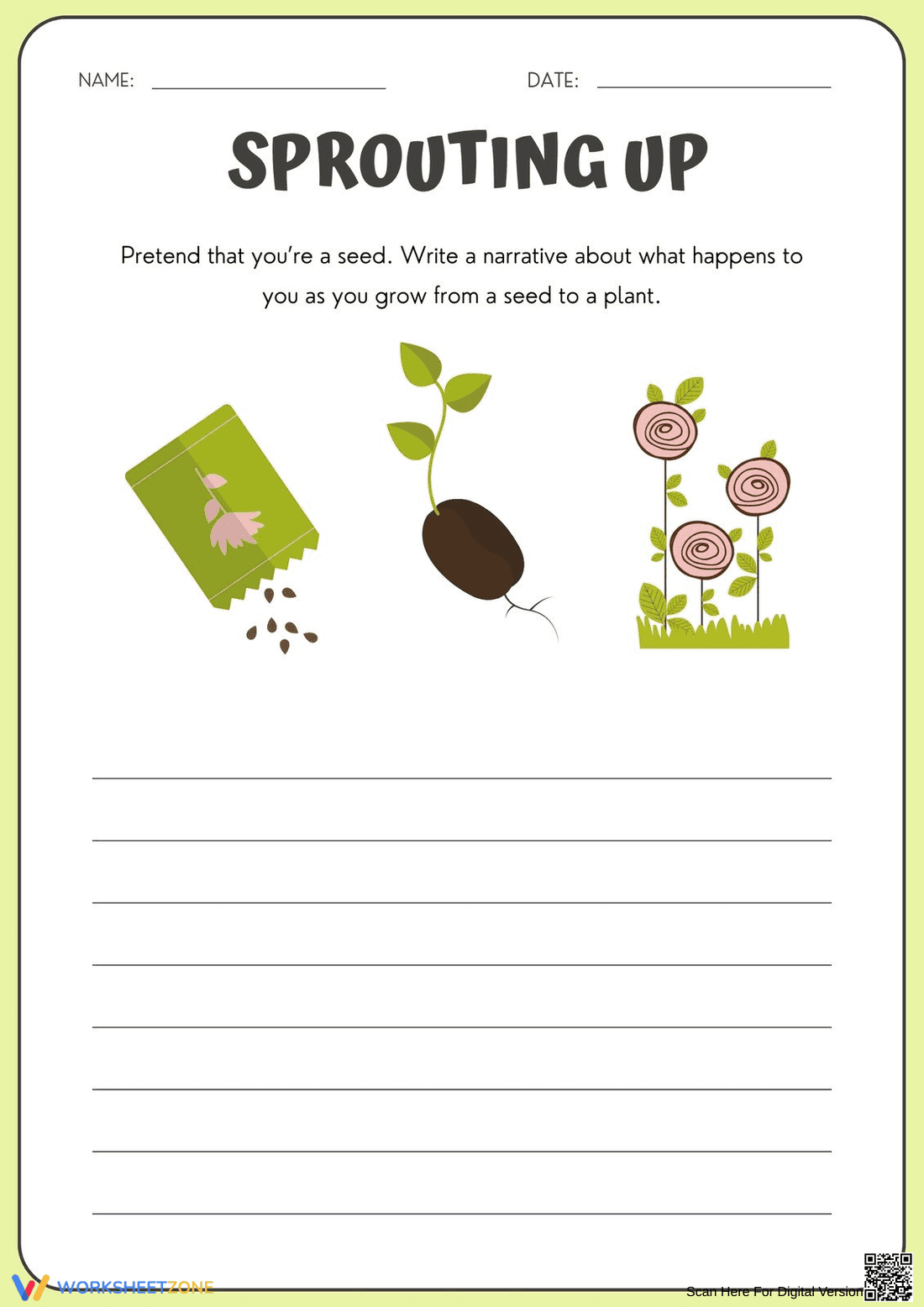

Grade 3 Narrative Writing — Printable No-Prep Worksheet
Paste this activity's link or code into your existing LMS (Google Classroom, Canvas, Teams, Schoology, Moodle, etc.).
Students can open and work on the activity right away, with no student login required.
You'll still be able to track student progress and results from your teacher account.
This Grade 3 narrative writing worksheet prompts students to imagine life from a seed's perspective. By writing a first-person story about growing into a plant, learners practice sequencing events and using descriptive details. The creative prompt naturally integrates science concepts with essential English Language Arts writing skills.
At a Glance
- Grade: 3 · Subject: ELA
- Standard:
CCSS.ELA-LITERACY.W.3.3— Write narratives to develop real or imagined experiences- Skill Focus: Narrative Writing
- Format: 1 page · 1 writing prompt · No answer key · PDF
- Best For: Independent writing practice
- Time: 20–30 minutes
This single-page resource features a clear story starter titled "Sprouting Up." Students pretend to be a seed and describe their journey growing into a plant. The page includes three illustrations—a seed packet, a sprouting seed, and roses—to inspire storytelling. Below the prompt, students have nine generously spaced lines to draft their narrative.
Zero-Prep Workflow
- Print (1 minute): Simply download the PDF and print a class set. The black-and-white friendly design ensures clear copies.
- Distribute (1 minute): Hand out the single page to students. The instructions are self-explanatory, requiring no complex modeling.
- Review (3 minutes): Briefly discuss the illustrations and remind students to use transition words like "first," "next," and "finally" as they write.
Total teacher prep time is under two minutes, making this an ideal activity for emergency sub plans, morning work, or a quick writing center rotation.
Standards Alignment
This activity aligns directly with CCSS.ELA-LITERACY.W.3.3: Write narratives to develop real or imagined experiences or events using effective technique, descriptive details, and clear event sequences. It also supports cross-curricular connections to early elementary science standards regarding plant life cycles. Both standard codes can be copied directly into lesson plans, IEP goals, or district curriculum mapping tools.
How to Use It
Teachers can deploy this worksheet during an independent writing block after a direct instruction lesson on first-person perspective. It also serves as an excellent extension activity following a science lesson on how plants grow. As students write, teachers can circulate and use this as a formative assessment, observing whether learners are successfully maintaining the first-person point of view ("I grew roots") rather than slipping into third person. Expected completion time is 20 to 30 minutes.
Who It's For
This worksheet is primarily designed for third-grade students, though it can easily be adapted for second graders needing a challenge or fourth graders requiring foundational narrative review. To differentiate for developing writers, teachers might provide a word bank of transition words or plant-related vocabulary (e.g., soil, water, sunlight, roots). This activity pairs perfectly with a read-aloud of a picture book about seeds or a classroom anchor chart detailing the stages of a plant's life cycle.
Developing strong narrative writing skills requires consistent, structured practice with engaging, age-appropriate prompts. When students work on CCSS.ELA-LITERACY.W.3.3 to write narratives to develop real or imagined experiences, they build essential cognitive frameworks for sequencing events and utilizing descriptive language. According to Fisher & Frey (2014), providing students with clear, constrained writing tasks—such as adopting a specific persona—reduces cognitive load and allows learners to focus deeply on structural elements rather than struggling to invent a topic from scratch. This targeted instructional approach ensures that young writers can successfully practice organizing their thoughts chronologically while experimenting with sensory details. By integrating visual cues alongside the prompt, this resource further supports comprehension and idea generation, making the complex task of narrative composition significantly more accessible and enjoyable for elementary learners.


